
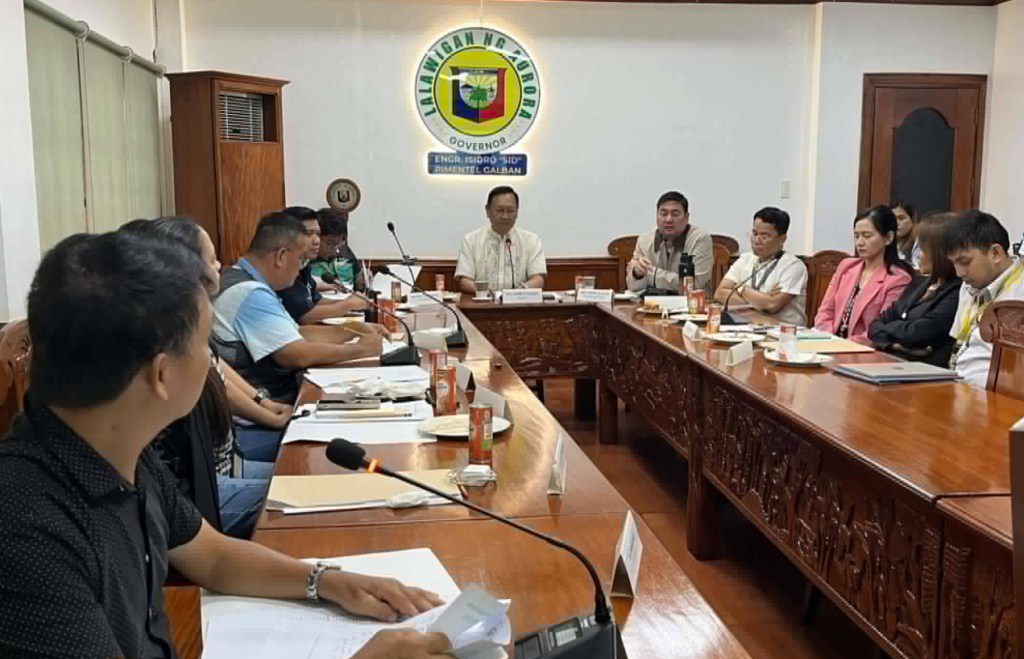
BALER, Aurora – The provincial government of Aurora has institutionalized an open government framework through Provincial Ordinance No. 646, or the Open Government Partnership (OGP) Ordinance of the Province of Aurora, approved on July 7, 2026.
Aurora Vice Governor Patrick Alexis Angara presented the ordinance during a press conference at the Governor’s Conference Hall, Aurora Provincial Capitol in Barangay Suklayin here on Thursday Aug. 13, highlighting measures aimed at strengthening transparency, accountability, citizen participation, and digital governance.
Angara said the ordinance is anchored on the global Open Government Partnership, an initiative that brings governments and civil society organizations together to promote transparent, accountable, and responsive governance.
“In simple terms, Open Government Partnership means that government and citizens work together as equal partners—making public decisions completely transparent, accountable, and responsive to every citizen,” Angara said.

According to Angara, the ordinance establishes Aurora as the first province in the Philippines to enact a binding local OGP ordinance, citing information from the Department of the Interior and Local Government (DILG).
The ordinance draws its legal foundation from provisions of the 1987 Philippine Constitution on integrity and transparency in public service, the right of citizens to information on matters of public concern, Executive Order No. 31, series of 2023, and other national policies promoting open government principles.
Angara said the ordinance defines key principles such as transparency, accountability, co-creation, citizen participation, the Open Government Action Plan (OGAP), and Participatory Governance Metrics (PGM).
Under the ordinance, transparency involves the proactive disclosure of accurate, timely, relevant, and accessible information on government decisions, budgets, programs, and performance.
Accountability requires public officials to justify their decisions and remain answerable for non-compliance, while co-creation provides mechanisms for government and stakeholders to jointly develop, implement, and evaluate policies and services.
The ordinance also establishes an Open Government Action Plan, a time-bound provincial framework containing measurable commitments and compliance indicators.
Open government throughout the governance cycle
Angara said open government principles will be integrated into the province’s governance lifecycle, from planning and budgeting to legislation, procurement, project implementation, and monitoring.
The Provincial Planning and Development Office (PPDO) and Provincial Development Council will lead efforts to integrate civil society organizations (CSOs) and 12 sectoral advisory bodies into the preparation of development plans and investment programs.

For budgeting, the Provincial Budget Office and concerned finance offices are tasked to conduct open budget hearings, publish digital budget dashboards, and disclose quarterly expenditure reports.
The Sangguniang Panlalawigan, meanwhile, will incorporate public participation into the legislative process through public committee hearings, technical working group dialogues, and the integration of stakeholder inputs into committee reports.
The ordinance also calls for greater transparency in government procurement, including livestreaming pre-bid conferences, bid openings, and contract awards and archiving recordings through the proposed Open Government Portal.
Provincial offices will likewise be required to maintain public-facing systems for monitoring the physical and financial progress of government programs, projects, and activities.
Open Government Portal, FOI mechanisms
A major component of the ordinance is the establishment of the Aurora Open Government Portal, a centralized online platform intended to provide public access to approved budgets, procurement awards, contracts, ordinances, financial statements, and other government information.
The ordinance also requires quarterly public disclosure of provincial revenues, expenditures, and development project progress.

A localized Freedom of Information (FOI) mechanism will establish procedures for receiving and processing information requests, designated receiving officers, response deadlines, and an appeals process.
Angara said information should also be presented in citizen-friendly formats, including simplified dashboards and machine-readable open data, while complying with the Data Privacy Act of 2012.
Citizens to have greater role in policymaking
The ordinance provides mechanisms for the participation of CSOs, people’s organizations, academe, the private sector, and other stakeholders in planning, budgeting, policy formulation, and legislation.
Under the proposed committee system integration, public consultations and technical working group discussions may be conducted during the referral stage, followed by committee hearings involving CSOs and experts.
Stakeholder recommendations may then be incorporated into committee reports before proposed measures proceed to plenary deliberations.
Angara said participatory governance will cover the entire policy cycle, from agenda-setting and drafting to legislative deliberation, budget authorization, implementation, and post-enactment review.
12 sectoral advisory bodies
The ordinance also provides for the creation or strengthening of 12 permanent sectoral advisory bodies under the Provincial Development Council.
Among the identified sectors are health and nutrition, education, infrastructure, justice and human rights, environment and natural resources, agriculture and fisheries, social services and welfare, and youth and sports development.
The advisory bodies will include representatives from provincial offices, accredited CSOs, academe, and the private sector.
Their functions include recommending sectoral priorities and reforms, assessing project implementation and community impact, reviewing performance against established targets, and proposing measures to improve public service delivery.
Their recommendations and reports are to be formally transmitted to the provincial executive and Sangguniang Panlalawigan and made accessible to the public through the Open Government Portal.
Equal government, non-government representation
One of the key institutional mechanisms under the ordinance is an OGP Steering Committee with an equal 50-50 voting structure between government and non-government representatives.
The government side will include the governor, vice governor, representatives of the Sangguniang Panlalawigan, provincial administrator, PPDO, budget, accounting, and information and communications technology offices.
The non-government side will consist of representatives from CSOs, people’s organizations, academe, and the private sector.
The non-government representatives will participate in co-creating the province’s six-year OGP Action Plan, monitoring government performance, and independently evaluating implementation.
The six-year action plan will cover 10 commitment areas, including transparency, anti-corruption, civic participation, accountability, digital transformation, fiscal openness, climate change, gender and inclusion, social justice, and media and academic freedom.
Compliance and sanctions
The ordinance also establishes monitoring and evaluation mechanisms through annual Participatory Governance Metrics assessments.
The PGM framework will measure citizen participation across five dimensions: access and inclusion, depth of participation, influence on decision-making, institutionalization, and accountability and feedback mechanisms.
Offices found deficient in meeting transparency or participation requirements will be required to submit written compliance and corrective action plans within prescribed deadlines.
Willful or repeated non-compliance may result in administrative proceedings under applicable Civil Service rules.
Angara said the ordinance is intended not only to make government information more accessible but also to provide citizens with a formal role in shaping policies, monitoring government programs, and holding public institutions accountable.
The provincial government expects the framework to be integrated into its development planning, investment programming, budgeting, legislation, and monitoring systems, making open government a continuing component of governance in Aurora. (Jason de Asis)
Photos courtesy of Jason de Asis





Leave a comment