
By Darryl John Esguerra
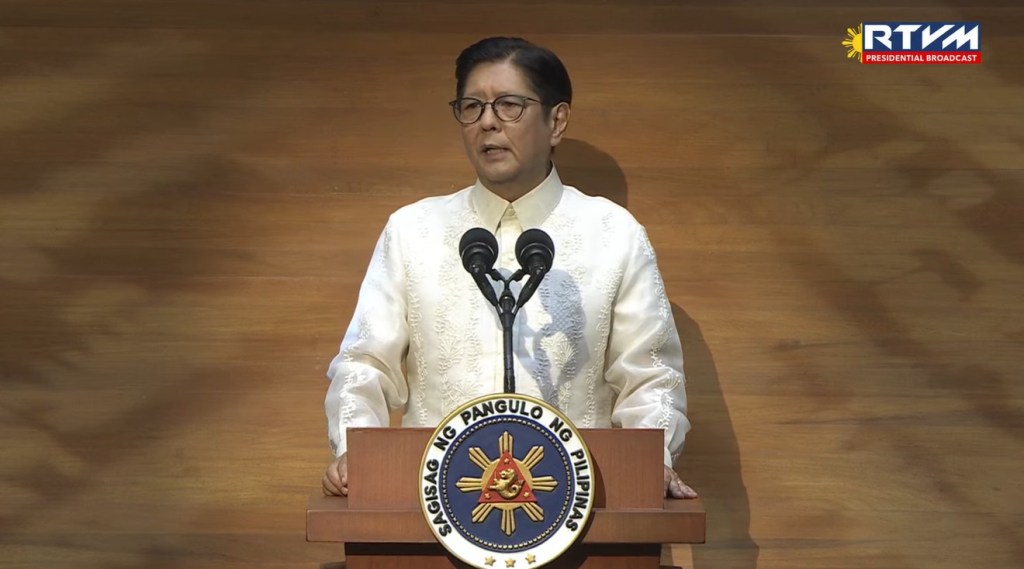
MANILA – President Ferdinand R. Marcos Jr. on Monday used his fifth State of the Nation Address (SONA) to draw a line between his administration’s first four years and its final stretch, presenting both an accounting of the government’s accomplishments and a roadmap for the remaining two years of his term centered on accountability, economic transformation, social protection, food and energy security, education and the defense of Philippine sovereignty.
Delivering his address before a joint session of Congress at the Batasang Pambansa Complex, Marcos spoke for one hour and 26 minutes, a bit longer than his one hour and 10-minute SONA in 2025, outlining what he described as the next phase of the administration’s push for a “Bagong Pilipinas” (New Philippines).
The President received repeated applause throughout the speech, with some of the loudest ovations coming after he vowed to pursue corruption cases regardless of political ties, defended the country’s sovereign rights in the West Philippine Sea, and promised that no Filipino would be left behind as economic gains continue to expand.
Anti-graft drive enters next phase
Marcos opened his penultimate SONA to provide an update on his previous address’ main attraction — the flood control scandal — which is now entering a decisive stage following the government’s sweeping investigation into alleged irregularities in flood control projects.
Marcos announced that the Ombudsman is now preparing to file multiple cases against former House Speaker Martin Romualdez, his cousin.
The probe stemmed from the administration’s review of thousands of flood mitigation projects after widespread flooding exposed unfinished, substandard and allegedly “ghost” infrastructure despite billions of pesos in government spending.
“Malapit na ang paghahain ng patung-patong na kaso laban sa dating Speaker. Masakit man sa akin ito, pero kailangan nating gawin ang tama (The filing of multiple cases against the former Speaker is drawing near. Painful as it may be for me, but we must do what is right),” Marcos said.
Marcos underscored that family ties would not stand in the way of accountability.
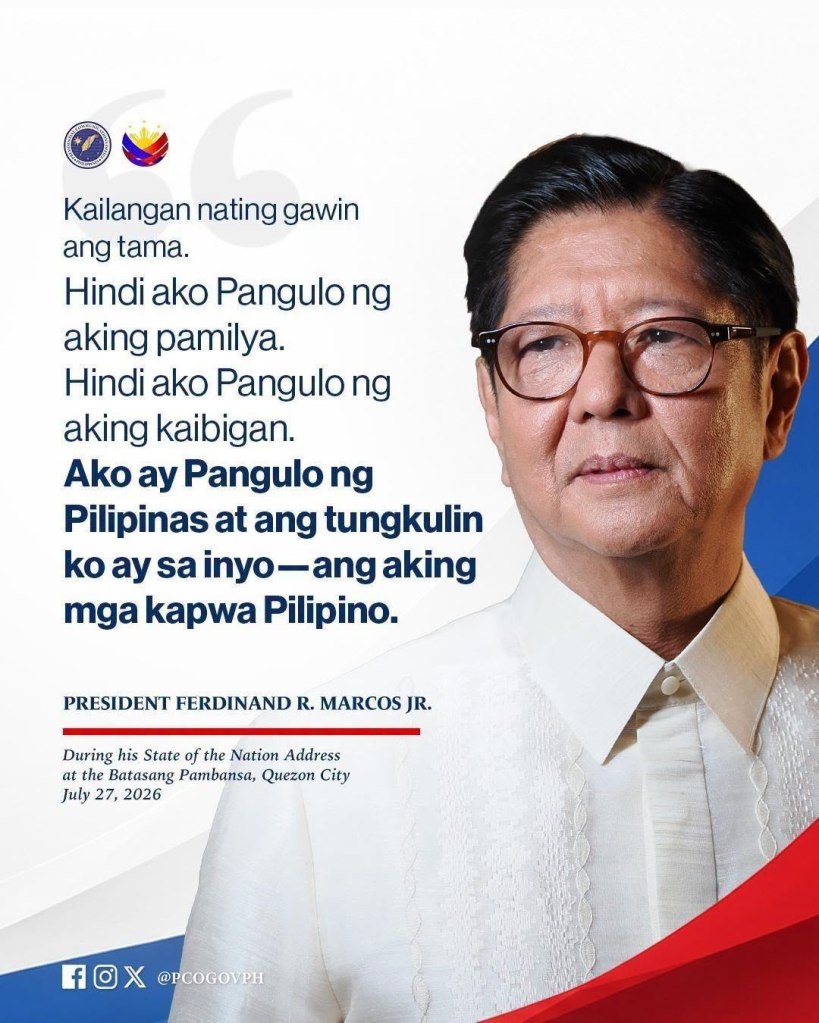
“Hindi ako Pangulo ng aking pamilya. Ako ay Pangulo ng Pilipinas at ang tungkulin ko ay sa inyo, mga kapwa ko Pilipino (I am not the President of my family. I am the President of the Philippines, and my duty is to you, my fellow Filipinos),” he added, receiving the loudest cheer throughout the event.
He said investigators followed evidence “without fear or favor,” resulting in criminal charges against contractors, senior Department of Public Works and Highways officials and lawmakers.
The President added that nearly PHP25 billion worth of public funds and assets have been recovered, frozen or preserved, while more than PHP800 million has already been returned to the National Treasury.
He assured the public that all recovered funds would be returned to the government, while prosecution would now proceed before the Ombudsman and the strengthened National Prosecution Service.
Economy, investments, emerging industries
Beyond anti-corruption, Marcos framed the country’s economic strategy around attracting high-value industries rather than relying solely on traditional manufacturing.
He said government reforms, including the Green Lanes for Strategic Investments, have already facilitated more than PHP6 trillion worth of investments over the past three years, projected to generate over 400,000 jobs.
Marcos said the Philippines is positioning itself deeper into global value chains by expanding advanced manufacturing, pharmaceuticals, logistics, luxury goods, semiconductors and artificial intelligence (AI).
Among the flagship initiatives he highlighted was the US-backed Pax Silica Industrial Hub, which he described as an AI-driven manufacturing and logistics ecosystem under the Luzon Economic Corridor.
He said the project would create quality jobs while strengthening the country’s competitiveness in advanced technology industries.
The President also pointed to the country’s expanding trade footprint, noting that the Philippines now has 23 free trade agreements either in force or under negotiation, including an upcoming Comprehensive Economic Partnership Agreement with the United Arab Emirates.
Lower electricity costs, nuclear energy
One of the biggest applause lines of the speech came when Marcos turned to high electricity prices.
Calling the practice unfair to consumers, he urged Congress to immediately amend the Electric Power Industry Reform Act (EPIRA) to prohibit charging systems loss to electricity users.
“Hindi naman kasalanan ng konsyumer kung bakit nagkaroon ng systems loss. Kaya hindi naman tama na kailangan sila pa ang pagbabayarin dito (Consumers are not responsible for system losses. It is therefore unfair that they are the ones being made to pay for them),” he said.
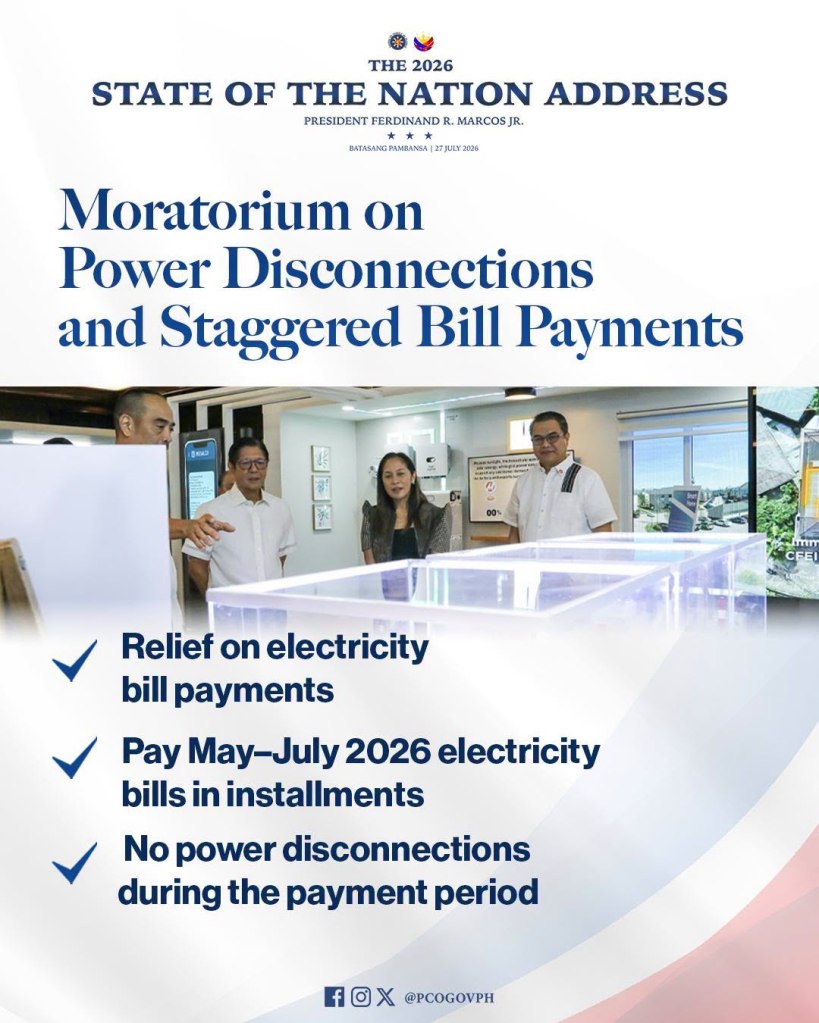
He added that consumers are not only billed for systems loss but are also made to pay value-added tax on those charges.
“Therefore, we the people request — no, we demand — the immediate amendment of the EPIRA and to prohibit charging systems loss against consumers, including the value-added tax thereon,” he stressed.
The declaration drew one of the longest standing ovations inside the Batasang Pambansa.
Marcos likewise reaffirmed the administration’s energy diversification strategy, saying the country would continue expanding renewable energy while moving forward with preparations for nuclear energy, describing it as a critical component of achieving long-term energy security and lower power costs.
Food security, agriculture, water
Marcos reiterated that food security remains among his administration’s top priorities.
He cited continued investments in irrigation systems, farm mechanization, post-harvest facilities, cold storage, modern agricultural equipment and digital technologies to raise farm productivity.
The President also highlighted the construction of dams and reservoir irrigation systems across the country, saying these projects are intended to guarantee year-round water supply, increase rice production and strengthen climate resilience.
He said the administration would continue modernizing agriculture through satellite-assisted monitoring, AI and solar-powered irrigation systems while expanding support for farmers and fisherfolk.
Education
Marcos devoted a substantial portion of his address to education, saying learning recovery and student welfare remain central to the administration’s long-term agenda.
He announced that the government would feed more than 4.5 million Kinder, Grade 1 and nutritionally at-risk learners through the expanded school-based feeding program.
To address student welfare, the President said the government would deploy the first 10,000 School Counsellor Associates in public schools as he noted recent incidents of violence in schools involving students.
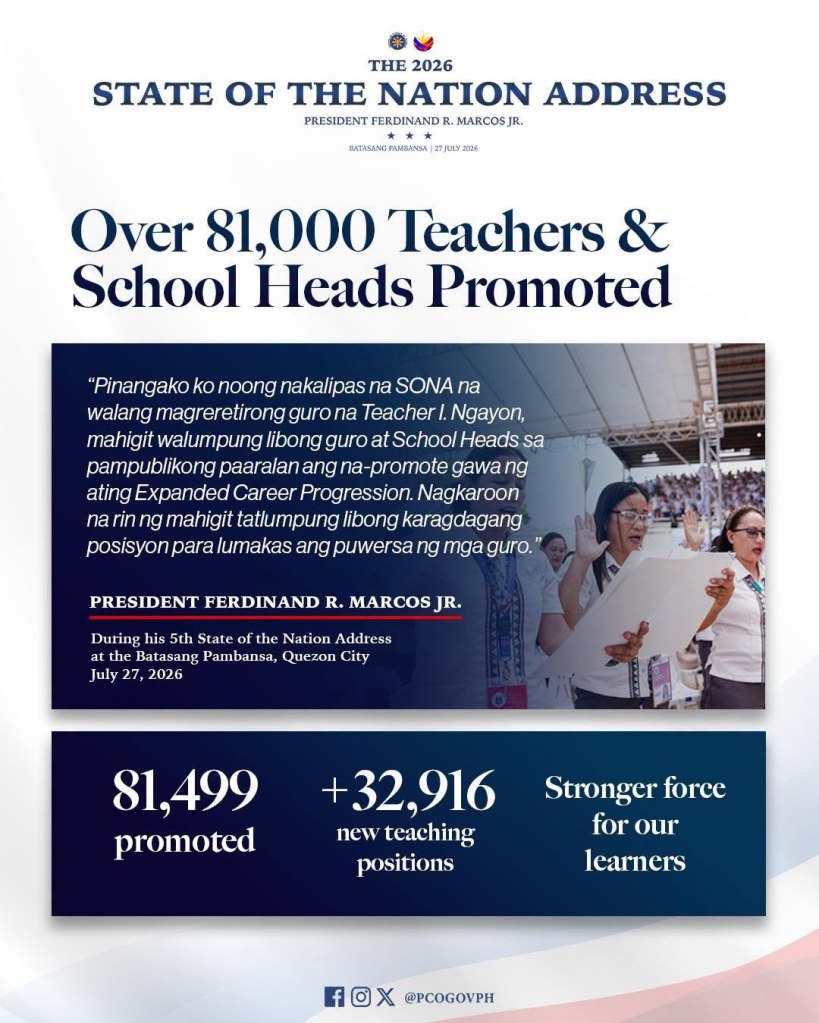
Marcos also reported that more than 80,000 teachers and school heads have already been promoted under the Expanded Career Progression Program, while over 30,000 additional teaching positions have been created.
To address classroom shortages, he announced that the private sector, through public-private partnerships, would initially build more than 16,000 classrooms in Luzon, with similar programs planned for the Visayas and Mindanao.
Healthcare and social protection
Marcos also outlined major healthcare reforms, saying the administration is shifting toward preventive healthcare while expanding PhilHealth benefits.
He said the government’s YAKAP Program has already provided medical consultations to 4.5 million Filipinos out of 25 million registered beneficiaries.
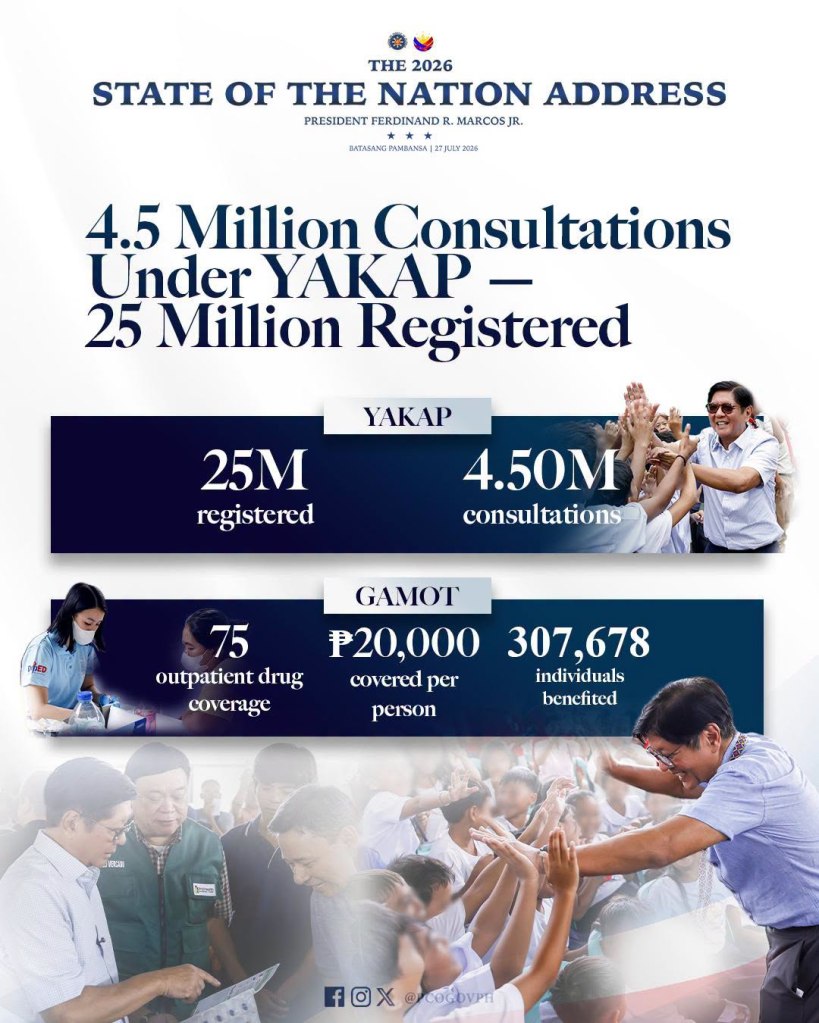
The President said PhilHealth’s GAMOT Program now covers 75 essential medicines, while more than 2,000 medicines have been exempted from value-added tax, including hundreds used for cancer, hypertension, diabetes and mental health treatment.
He also reported that nearly 3 million Filipinos have already benefited from the government’s Zero Balance Billing program in Department of Health hospitals since its launch after last year’s SONA.
Meanwhile, more than 8 million patients have received assistance through the Medical Assistance for Indigent and Financially Incapacitated Patients (MAIFIP), which has now been integrated into the eGovPH application to simplify access.
Marcos said savings recovered from corruption investigations, including the flood control probe, have been redirected to education, food programs, healthcare, PhilHealth and medical assistance.
WPS defense
Foreign policy and national security formed the emotional climax of the address as Marcos responded to recent tensions in the West Philippine Sea.
The remarks came days after two Philippine Navy personnel were injured during a violent confrontation with the China Coast Guard near Ayungin Shoal, prompting the President to personally visit the wounded servicemen in Palawan and summon the Chinese ambassador to Malacañang. The incident followed the publication of Chinese state media of a propaganda video on the dispute projecting Filipinos as “monkeys”.
Without mentioning China by name, Marcos denounced recent insults directed at Filipinos.
“Our unity and collective consciousness are challenged now greater than ever before. A common threat lies before us, directed against our dignity and self-respect as a people,” Marcos said.
“Of late, our very humanity has been called into question.”
He then delivered one of the speech’s most memorable passages.

“Let me remind our friends and our detractors: Filipinos are a noble, kind, gracious, and great race. We are not greedy. We are not racists. We are not liars. We are respectful, and we are dignified. We are Filipinos, and we do not yield,” he said, earning thunderous applause and chants from the crowd.
Marcos reaffirmed the Philippines’ commitment to the 2016 Arbitral Award, calling it a definitive benchmark under the United Nations Convention on the Law of the Sea (UNCLOS).
“Your government will do all that is necessary to continue upholding this Award, utilizing every peaceful and legal means available to the Republic against any attempt, foreign or domestic, to undermine this achievement,” he said.
He also honored the Armed Forces of the Philippines, Philippine Coast Guard and Filipino fisherfolk for continuing to assert the country’s sovereign rights despite growing risks in the West Philippine Sea.
The Chief Executive also rallied Filipinos to remain united.
“Sa mga pang-aalipusta, hindi tayo matitinag. Sa manlulupig, hindi tayo pasisiil (We will not be shaken by insults. We will not be subdued by those who seek to oppress us).”
Continuity over reinvention
Rather than unveiling sweeping new flagship programs, Marcos used his fifth SONA to argue that the administration is entering a new phase focused on completing reforms already underway.
From pursuing corruption cases, lowering electricity costs, expanding healthcare and education, attracting strategic investments, strengthening food and energy security, modernizing agriculture, and defending Philippine sovereignty, the President cast the remaining two years of his administration as a period of implementation rather than transition.
“Sa nalalabing dalawang taon ng administrasyon, tatapusin natin ang mga nasimulan, at tutuparin ang ating pangako sa sambayanan (In the remaining two years of my administration, we will finish what we’ve started and we will fulfill our promises to the people),” he said.
“My beloved countrymen, let us continue the work that we have started. To make the Philippines the country that Filipinos deserve,” Marcos added.
“There is no nobler cause than this. We do this for our children. We do this for our future. We can but do this, because we love our country and we love our people.” (PNA)




Leave a Reply