
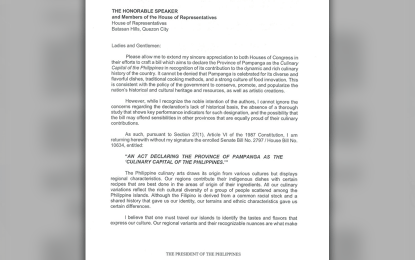
MANILA – President Ferdinand R. Marcos Jr. has vetoed a bill that sought to declare Pampanga as the “Culinary Capital of the Philippines.”
In a letter to the House of Representatives dated March 12, Marcos explained that while Pampanga’s culinary contributions are widely recognized, officially designating it as the country’s culinary capital could undermine the diversity of Philippine cuisine.
“It cannot be denied that Pampanga is celebrated for its diverse and flavorful dishes, traditional cooking methods, and a strong culture of food innovation,” Marcos said in his veto message.
“This is consistent with the policy of the government to conserve, promote, and popularize the nation’s historical and cultural heritage and resources, as well as artistic creations,” he added.
The President, however, noted that the bill lacked a historical basis and key performance indicators to justify such declaration, warning that it could offend other provinces with similarly rich culinary traditions.
“I cannot ignore the concerns regarding the declaration’s lack of historical basis, the absence of a thorough study that shows key performance indicators for such designation, and the possibility that the bill may offend sensibilities in other provinces that are equally proud of their culinary contributions,” Marcos said.
Marcos stressed that Filipino cuisine reflects the country’s cultural and geographic diversity, shaped by the distinct culinary traditions of its regions.
“Our regions contribute their indigenous dishes with certain recipes that are best done in the areas of origin of their ingredients. All our culinary variations reflect the rich cultural diversity of a group of people scattered among the Philippine islands,” he said as he underscored the importance of preserving this diversity.
At a Palace briefing on Thursday, Palace Press Officer and Presidential Communications Office Undersecretary Claire Castro confirmed that Marcos vetoed Senate Bill No. 2797 and House Bill No. 10634 titled “An act declaring the province of Pampanga as the culinary capital of the Philippines.”
“Maganda kasi po ‘yung bill, pero magke-create ito ng discrimination (The bill is good, but it may create discrimination),” Castro said.
The bill, authored by Pampanga lawmakers including former President Gloria Macapagal-Arroyo, aimed to recognize Pampanga’s culinary heritage.
Arroyo earlier said the declaration would benefit local communities by attracting more visitors and creating economic opportunities.
Despite the veto, Ivan Henares, Secretary-General of the UNESCO National Commission of the Philippines and Commissioner of the National Commission for Culture and the Arts, said the decision does not diminish Pampanga’s culinary significance but recognizes that the country’s strength lies in its regional diversity.
“I hope our kabalens understand the wisdom behind this veto. It is not saying that Kapampangan cuisine is not good. It just acknowledges that in a nation as diverse as ours, no one region can claim to have the best food,” Henares wrote in a Facebook post.
“We should not be competing with each other for bragging rights and empty titles. Focus on sustainable programs (such as policies on geographical indication), not just trivial things. Let’s determine ‘key performance indicators’ and work towards those,” he added. (PNA)
 Ang Pahayagan
Leave a comment