
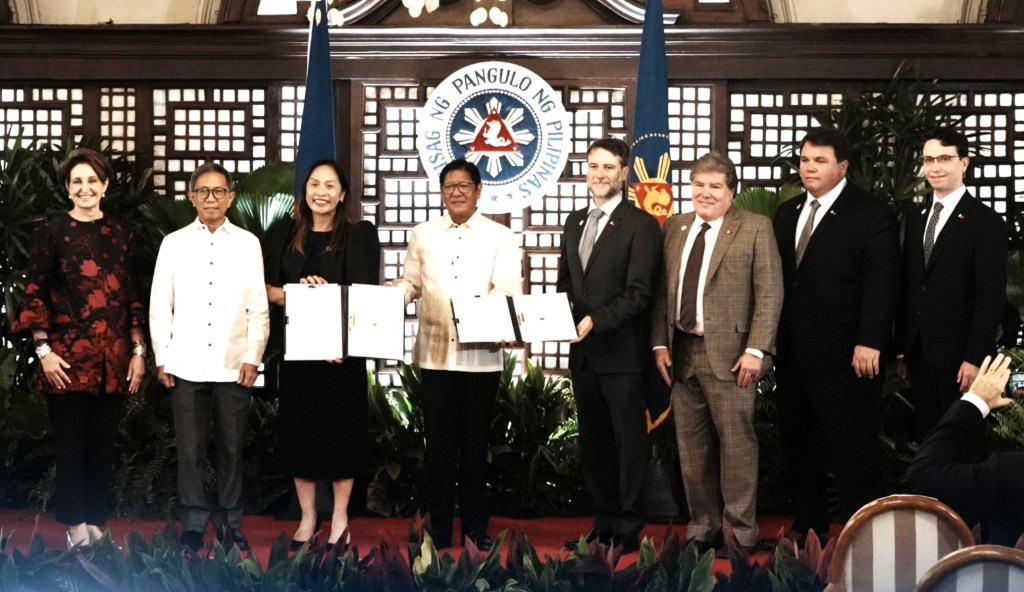
ZAMBALES — Hydrogen reserves in Zambales may finally enter the exploration stage after President Ferdinand Marcos Jr. approved landmark Petroleum Service Contracts (PSCs) to boost energy security in the country.
According to the Department of Energy (DoE), President Marcos unveiled in Malacañang on October 8 eight new PSCs covering exploration areas across the Sulu Sea, Cagayan, Cebu, Northwest Palawan, East Palawan, and Central Luzon. The contracts represent a potential investment commitment of around US$207 million overa seven-year exploration period.
Two of these contracts—PSC No. 83 and PSC No. 84—were for native hydrogen exploration in Central Luzon. Both were awarded to Koloma, Inc., a company based in the United States.
SC 83 covers 126,645 hectares while SC 84 covers 85,082 hectares, the DoE said.
The hydrogen exploration contracts are reputedly the world’s first competitive bid round for native hydrogen.

The DoE said the eight PSCs “signal the reinvigorated confidence in the Philippines upstream energy sector,” paving the way for new gas exploration projects amid the decline of the Malampaya Gas Field.
“These service contracts signify not only our determination to secure new energy sources, but also our readiness to embrace innovation and sustainability while reducing import dependence,” said Energy Secretary Sharon S. Garin.
“This is also about empowering our regions, building local capacity, and creating opportunities for our people,” she added.
The Philippines was the first country to create a policy framework for native hydrogen exploration and held a bidding round for exploration rights in 2024.
Previously, the DoE has identified Zambales and Pangasinan as key areas for exploration of naturally occurring hydrogen gas in geologic formations. The DOE’s technical team, in close coordination with the DENR-Mines and Geosciences Bureau (MGB) Regional Office No. 3, has conducted field assessments at the Mangatarem Hot Spring in Pangasinan, and the Botolan Hot Spring and Nagsasa Seeps in Zambales.
Last June, the Department of Science and Technology (DOST) said a recent study had revealed that the Nagsasa Seep in San Antonio town “has the highest recorded gas seepage capable of producing renewable energy to meet the power needs of the town.”
The Nagsasa gas seeps, also known as “outgassing” have released a record 800 tons of geologic hydrogen, an amount that surpasses the previous record of 200 tons reported in Albania in 2024, the DOST added.
The study indicated that the surface outgassing in San Antonio may generate 12,861 to 15,185 megawatt-hour (MWh) per year. This is equivalent to about 42 percent of the estimated 36,600 MWh demand in San Antonio, said Dr. Karmina A. Aquino, a geological chemist and fellow from the DOST-Philippine Nuclear Research Institute, who first measured with some colleagues the outgassing rate in San Antonio. — Taktikom News & Features
TOP 📸: President Ferdinand Marcos Jr. and Energy Secretary Sharon S. Garin present contracts for hydrogen gas exploration to officials of Koloma, Inc., along with US Ambassador MaryKay L. Carlson and DENR Secretary Raphael Lotilla. (DoE photo)
 Ang Pahayagan
Leave a comment