
The Department of Science and Technology (DOST) rolls out three major science, technology, and innovation facilities in Central Luzon to bring its services closer to the communities.
DOST secretary Renato U. Solidum Jr., together with DOST Undersecretary Sancho A. Mabborang, and DOST Region 3 Director Julius Caesar V. Sicat led the inauguration of the Smarter Approaches to Reinvigorate Agriculture as an Industry Centralized National Hub for Regional Operations (SARAI CeNTRO), the Innovation Hub (iHub), and the Advanced Manufacturing Center (AMCEN).
Solidum, in his message, emphasized the agency’s thrust to make science more accessible and relevant to Filipinos, especially those in the regions.
“In the past, accessing government services often meant travelling long hours to the capital or central office, and this can be time-consuming, costly, and challenging, especially for those living in remote communities. Today, we are changing that approach. DOST is bringing science closer to the people, meeting communities where they are instead of expecting them to visit us and come to Manila.”
Solidum highlighted that the facilities in Central Luzon reflect DOST’s “bold journey towards helping the country and our people in their socio-economic development.” He further noted that these initiatives are aligned with the administration of President Ferdinand R. Marcos Jr., who “emphasized the role of science, technology, and innovation in boosting agriculture in the country and revitalizing our industries.”

📸 SARAI is another DOST flagship program aimed at supporting local farmers to improve their agricultural productivity using knowledge-based, smart technologies.
SARAI is a flagship initiative developed in partnership with UP Los Baños (UPLB) to improve agricultural productivity in the countryside to help farmers attain better agricultural products through the application of smart technologies.
“The SARAI is a program that I really wanted to implement since the President has directed DA and DOST to implement SARAI all over the country. It took us seven years to prepare for this,” Solidum explained.
The Secretary added that SARAI brings together data-driven tools such as crop modeling, satellite remote sensing, and geographic information system-based pest identification systems, which will help farmers make informed decisions, increase yields, and improve profitability.
“We will be able to bring the innovative tools of the SARAI Project closer to our farmers in the region,” he said. “We need to treat agriculture as a business, where the overall system and efforts are geared towards maximizing the profit for our farmers.”
Director Sicat added that SARAI CeNTRO is especially vital to Central Luzon, the country’s “rice granary”, as it strengthens support for food production and smart agriculture.
“SARAI will be a big help to provide proper guidance to our farmers, especially as Central Luzon continues to support the food requirements of Metro Manila,” Sicat emphasized.
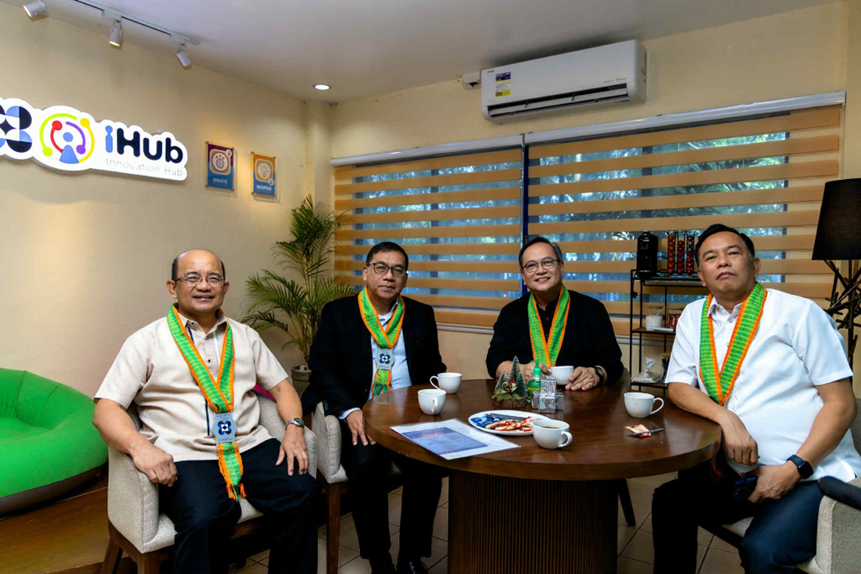
📸 iHub aims to provide a workspace where researchers can collaborate with mentors and investors to accelerate the development of their projects.
On the other hand, the Innovation Hub (iHub), serves as a collaborative workspace for innovators, students, researchers, and entrepreneurs.
“The iHub has a lot of opportunities for us to provide space for innovators, especially young learners, to leverage innovation,” said Solidum. “We hope this facility will become the birthplace of technology-based products here in Central Luzon.”
Undersecretary Mabborang explained that iHub is part of the DOST growing innovation ecosystem, with Central Luzon’s hub being the 64th Innovation Hub established nationwide.
“This is a physical space where researchers, inventor-students, and the business community can interact; from ideation, incubation, and inspiration, up to startup creation,” Mabborang said.
He added that DOST envisions these hubs to eventually attract venture capitalists, angel investors, and technology entrepreneurs, and that P148 million in funding has been approved for iHub development in provinces next year.
“I am very happy that DOST Region 3 has curated the Innovation Hub. This will deliver cutting-edge technologies and empower the countryside,” he said.
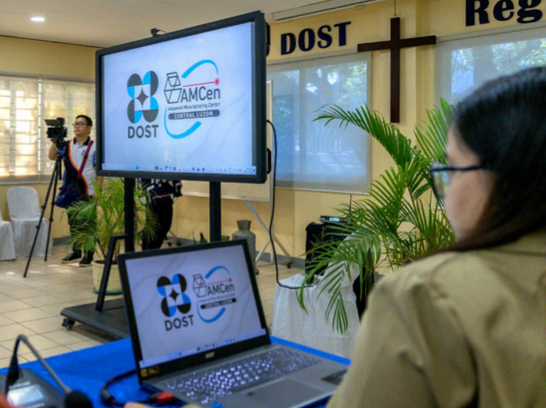
Finally, the AMCEN was inaugurated to support the growth of the manufacturing and industrial sectors of the region. The facility is equipped with state-of-the-art 3D printing and Industry 4.0 tools, which enable industries, students, and universities to create prototypes and develop advanced products using various advanced tools including 3D printing technologies.
“With industrialization ramping up here in Central Luzon, particularly in manufacturing, DOST aims to contribute to its growth by establishing a hub where we can strengthen the research and technological capability of our industries,” Solidum said.
Mabborang emphasized how 3D printing revolutionizes product design and prototyping.
“Before, it would take a week or a month to make a prototype. Now, you can program it on a computer, print it with a 3D printer, and create the prototype in several minutes,” he explained. “This transforms not only the way we do things, but it will also have an impact on the industry.”
Further, Sicat also shared that Central Luzon’s AMCEN’s additive manufacturing laboratory has begun partnerships with Jose B. Lingad Memorial General Hospital to use 3D printing in medical applications.
The launch of SARAI, iHub, and AMCEN encapsulates the DOST’s guiding vision of “Agham na Ramdam,” science that is genuinely felt by the people.
“These three initiatives are anchored on a simple yet meaningful goal in DOST: To provide solutions and opportunities for everyone, opportunities to upgrade their lives,” Solidum said. “Through science, technology, and innovation, and our spirit of collaboration and faith, we can show that science will really create an impact for our people, especially in the regions and provinces.”
Sicat expressed his gratitude to the DOST leadership for their strong regional support saying, “it’s not every day that we have a secretary and undersecretary who wholeheartedly support our regional operations. Let us take this opportunity to strengthen science-based development for our people.”
As DOST continues its efforts to decentralize innovation and empower local communities, the launch of these three facilities in Pampanga serves as a powerful statement that science and technology are not confined to laboratories or offices in Manila but are tools for progress available to every Filipino across the nation.
“They are not merely concrete and steel or plastic features,” Solidum concluded. “They are doors to new possibilities created by innovation, platforms of change and transformation where we can turn the dreams and hopes of the Filipino people into realities from ideas for a brighter future that benefits everyone.”
The establishment of SARAI, iHub, and AMCEN in Central Luzon is one of the many initiatives of the Department of Science and Technology (DOST) aimed at providing science-based, innovative, and inclusive solutions across four strategic pillars: human well-being, wealth creation, wealth protection, and sustainability. These pillars embody the mantra OneDOST4U: Solutions and Opportunities for All. (PIA)
 Ang Pahayagan
Leave a comment